Reference design — not client work
Overdue Invoice Chasing
How to automatically track unpaid invoices and send escalating reminders, reducing days sales outstanding without awkward manual conversations.
Workflow Overview
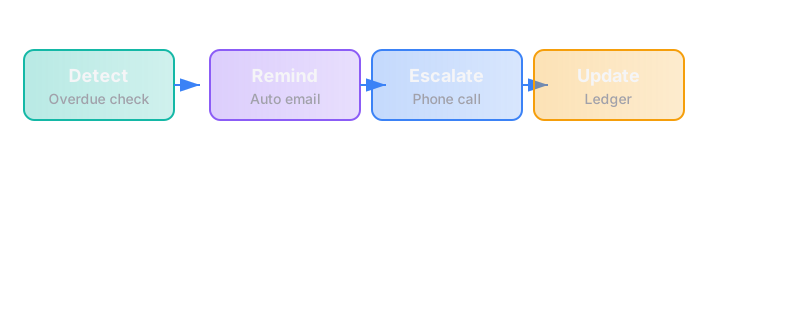
The trigger
An invoice passes its due date without payment.
The steps
Step 1: Invoice Created and Sent
- Invoice is generated with:
- Client name and contact details (billing contact, not just primary contact)
- Invoice number and date
- Amount due
- Due date (e.g., Net 15, Net 30)
- Payment instructions (bank details, payment link, etc.)
- Invoice is sent via email or billing platform
- Invoice record is created in the system with tracking enabled
Tools: Billing system (Stripe, Wave, QuickBooks, Xero), CRM or spreadsheet for tracking
Failure mode: Invoice is sent to the wrong person; payment details are incorrect; invoice is lost in transit
Fix: Confirm billing contact before sending; validate payment details; track delivery/open status
Step 2: Monitor Due Dates
- System checks daily for invoices approaching or past due date
- Invoices are categorized by days overdue:
- 0-3 days before due: Reminder preparation
- 0 days (due date): No action (give client benefit of doubt)
- 1-7 days overdue: First reminder
- 8-14 days overdue: Second reminder + phone call
- 15-30 days overdue: Escalated reminder + senior contact
- 30+ days overdue: Final notice + potential suspension of work
Tools: Billing system with aging reports, automation platform (n8n, Zapier), calendar for follow-up tasks
Failure mode: Invoices are missed; reminders are sent too aggressively or too late
Fix: Daily automated check; escalation schedule documented and followed consistently
Step 3: Send First Reminder (1-7 days overdue)
- Automated email is sent with:
- Polite tone ("Just checking in" rather than "You owe us")
- Invoice details (number, amount, original due date)
- Payment link or instructions (make it easy to pay)
- Offer to answer questions or resolve issues
- Email is tracked (opened? clicked?)
- Task is created for manual follow-up if no response in 3 days
Tools: Email system, billing platform, automation
Failure mode: Reminder is too aggressive and damages the relationship; or too weak and ignored
Fix: Standardized reminder language that is firm but polite; tone tested on actual clients
Step 4: Escalate if No Response (8-14 days overdue)
- Second reminder is sent (more direct tone)
- Phone call is made to billing contact:
- Confirm they received the invoice
- Ask if there are any issues or questions
- Agree on a payment date
- Call outcome is recorded:
- Paid: Close the loop
- Promise to pay: Set reminder to follow up on promised date
- Dispute: Log the dispute and escalate internally
- No answer: Leave voicemail; schedule another attempt
Tools: Phone system, CRM for call logging, calendar for follow-up
Failure mode: Call is avoided; outcome is not recorded; no clear next step
Fix: Standard call script; mandatory outcome field; automatic follow-up scheduling
Step 5: Senior Escalation (15-30 days overdue)
- Email is sent to senior contact (owner, CFO, or primary contact's manager)
- Message is more direct:
- Invoice is now significantly overdue
- Work may be suspended if not resolved
- Clear deadline for payment
- Work suspension warning is issued (if applicable to engagement terms)
- Decision is made on whether to continue work
Tools: Email system, CRM
Failure mode: Escalation is too aggressive and burns the relationship; or too weak and ignored
Fix: Escalation is based on agreed terms; language is consistent with contract; decision documented
Step 6: Final Actions (30+ days overdue)
- Final notice is sent (formal demand for payment)
- Work is suspended (if contract allows)
- Decision is made:
- Continue pursuit: Engage collections or legal (if amount justifies)
- Write off: Accept the loss and close the account
- Payment plan: Negotiate structured payment if client is cooperative
- Outcome is recorded for future reference
Tools: Billing system, legal counsel (if needed)
Failure mode: No action is taken; invoice is forgotten; pattern is not analyzed
Fix: Mandatory decision at 30 days; regular review of aging reports; pattern analysis
The failure modes
| Failure | Impact | Detection | Prevention |
|---|---|---|---|
| Invoice sent to wrong person | Payment is delayed indefinitely | Delivery tracking; client confirmation | Confirm billing contact before sending |
| Invoice details are wrong | Client can't pay or disputes the amount | Pre-send validation; client confirmation | Double-check amounts and details before sending |
| Reminder timing is off | Relationship is damaged or payment is delayed | Aging report review | Automated schedule with documented escalation path |
| Call is avoided | No progress on payment | Call attempt logging | Multiple attempt times; voicemail with clear next step |
| Outcome not recorded | No learning; same mistakes repeated | CRM audit | Mandatory outcome field before closing task |
| Work continues on overdue invoices | More money at risk | Regular aging review | Automatic work suspension warning at agreed threshold |
| No final action at 30 days | Invoice becomes uncollectible | Aging report review | Mandatory decision at 30 days |
Rough build cost
| Component | Cost Range | Notes |
|---|---|---|
| Invoice tracking setup | $500-$1,500 | Integration between billing system and automation |
| Reminder automation | $800-$2,000 | Multi-stage email sequences with escalation logic |
| Call tracking + logging | $400-$1,000 | CRM integration; call script templates |
| Escalation workflow | $500-$1,200 | Senior contact identification; work suspension logic |
| Reporting + dashboard | $400-$1,000 | Aging reports; DSO metrics; collection effectiveness |
| Testing + handover | $300-$800 | QA + documentation + training |
| Total | $2,900-$7,500 | Depends on billing system and complexity |
These are typical market costs to build this reference design. If your version fits our scope bound (at most 3 systems, 10 steps, 1 trigger), our fixed price is $4,500 for a First Workflow Build.
Timeline: 3-4 weeks from scope sign-off to live system (our fixed-price build commits to 5 weeks from a signed spec, including testing and handover)
Rough ongoing cost (by hand)
If done manually:
| Task | Time per Week | Cost at $100/hr |
|---|---|---|
| Review aging report | 30 minutes | $50 |
| Send first reminders | 1 hour | $100 |
| Make follow-up calls | 2-3 hours | $200-$300 |
| Escalation emails | 30 minutes | $50 |
| Track outcomes | 30 minutes | $50 |
| Total | 4-5 hours/week | ~$450-$550/week |
Hidden cost: Lost cash flow, bad debt, inconsistent treatment of clients, awkward personal conversations
What this excludes
- Invoice generation — Creating the invoices themselves is a separate workflow
- Payment processing — Receiving and reconciling payments is a different system
- Legal collections — Engaging lawyers or collection agencies is a separate process
- Credit checks — Assessing client creditworthiness before engagement is a different workflow
Why this matters
Overdue invoices are a cash flow killer, especially for small practices:
- Cash flow disruption — Unpaid invoices mean you can't pay your own bills
- Bad debt — The older an invoice gets, the less likely it is to be paid
- Time waste — Chasing payments is time taken away from billable work
- Relationship strain — Awkward conversations happen when you're unstructured; professionalism reduces the friction
How we'd approach building this
- Audit current billing process — How are invoices created and sent? How are overdue invoices currently tracked?
- Define the escalation schedule — What are the exact touchpoints and timing? What's the tone at each stage?
- Integrate billing system with automation — Connect the billing platform to email and CRM
- Build the reminder sequences - Create email templates for each stage; set up automation
- Set up tracking and reporting — Aging reports, DSO metrics, collection effectiveness
- Test with historical data — Run the system on past invoices to validate the approach
- Handover — Document the process; train whoever owns billing
The runbook
Owner: [Named person on internal team — often the operator in a small practice]
Daily checks:
- Invoices due in the next 3 days
- Invoices 1-7 days overdue (first reminders)
- Invoices 8+ days overdue (escalation needed)
Weekly checks:
- Aging report review
- DSO calculation
- Collection effectiveness (how much was collected vs. how much was due)
Monthly checks:
- Bad debt analysis (invoices written off)
- Client payment behavior patterns
- Process improvements based on what's working
When things break:
- Check if the issue is with billing data, email delivery, or automation logic
- Manually send any missed reminders
- Investigate and fix the root cause
- Escalate to [support contact] if systemic
Questions this raises (for the client)
- What's your current DSO (days sales outstanding)? Do you track it?
- Who is responsible for chasing overdue invoices? Is that person consistent?
- What's your escalation process? Is it documented or ad-hoc?
- What percentage of invoices are paid on time? What happens to the rest?
- Do you have terms that allow you to suspend work on overdue invoices? Are they enforced?
Related teardowns
- New Client Intake — Collecting billing information at the start
- Proposal First Drafts — Including payment terms in proposals
- Weekly Status Reporting — Keeping clients informed to prevent disputes
- Assessment Funnel — Screening for clients who pay on time
See where you stand
This teardown is one piece of our method. The assessment will tell you whether you're ready to build, or what's missing first.
Take the free assessment